“To confer the gift of drawing, we must create an eye that sees, a hand that obeys, a soul that feels; and in this task, the whole life must cooperate. In this sense, life itself is the only preparation for drawing. Once we have lived, the inner spark of vision does the rest.”
–Maria Montessori
In Montessori education, art is already an integral part of the curriculum. Many families are drawn to Montessori programs–and children thrive in them–because of the emphasis placed on art concepts like beauty, attention, imagination, and spatial awareness, including the teaching of geometry from early childhood onward. Each classroom from Toddler to Upper Elementary is “rich in motives which lend interest to activity and invite the child to conduct his own experiences” (as Montessori described it) as well as to create: depending on age, season, or what the children are studying, you will have seen colored pencils, paint, modeling clay, etc. on the shelves of your child’s classroom. So why have an Arts Enrichment program in our school at all?
At AIMS, we use our dedicated Art time to extend the rich work already being done in the classrooms in a studio-like environment filled with authentic art materials and time to achieve deep focus on process: learning new techniques like blending, and being introduced to mediums which require extra training like oil and chalk pastels. Because their ideas are routinely respected and celebrated, kids raised in Montessori environments tend to have passionate interest in specific topics like electricity, hurricanes, Italy, or baking cookies (just a few that have come up this week!). Art enrichment provides the perfect time and space as well as materials and methods for pursuing these interests in an interdisciplinary manner. In keeping with Montessori’s approach to education as “helping the absorbent mind develop” rather than treating children like blank slates to be filled with ideas, in art, we respect each child’s vision while teaching them the skills to execute it well.
Montessori education encourages children to see the world as a heroic story in which they can and will play a vital role. Kids develop tolerance, a collaborative spirit, and a sense of self-efficacy, and teachers nurture the pursuit of meaning and inspiration
through academic inquiry. As such, in Art this year, our objective has been to analyze how artists throughout human history have used the elements of art–Line, Shape, Color, Value, Texture, Form and Space–to tell stories and express big ideas while applying what we learn to our own art work. In addition to learning about ancient Egyptian burial practices and the innovations of Renaissance masters, we’ve learned about contemporary artists like Basquiat, Kusama, Faith Ringgold, and Ruth Asawa, as well as “folk artists” like Grandma Moses. We remember that all great artists began as children and each one has something unique and different to teach us.
When viewing a new artwork, we use the “See/Think/Wonder”
metacognitive routine developed at Harvard, which guides children to make inferences based on their own observations. We start by describing exactly what we see, then leap to what that makes us think, and then ask questions about it. With questions come fresh ideas for creating.
We learn to think like artists using a
growth mindset and embracing messiness and mistakes. We don’t strive to be “good” at art in exchange for praise, we are all artists practicing our craft and improving based on what worked and what didn’t. (Try this at home: when your child shows something he/she has made and is proud of, instead of exclaiming “Great job!”--which is a reasonable and natural way to connect–try pausing for a minute and asking, “Tell me about this.” You could also mention something specific you’ve noticed and let him/her explain it. See what happens. Don’t feel like you have to be perfect, either!)
Whereas ⅔ of public school teachers say that fine arts are being crowded out of classrooms by tested subjects like math and English, at AIMS, our curriculum brings math, science, and language into the Art studio. Learning in context is central to the Montessori method, and
has been shown more recently to promote student engagement and deeper understanding and retention of content knowledge, as well as to imbue classroom learning with a sense of purpose while exposing children to skills and behaviors relevant to the adult world. For us as Montessorians, offering children professional-grade products and the freedom to explore in a prepared (structured) environment is a way to affirm their dignity and value not just as adults-in-training, but as complex human beings in their own right.
The art teacher works collaboratively with other AIMS teachers to create project-based learning opportunities like using Brazil as a model for our cardboard town (for Kindergartners studying South America) and creating three dimensional “trioramas” to bring to life the beloved Biography project in Lower Elementary. We understand that art, math and science are not in tension but are complementary: for example, this year in Art, Upper Elementary students studied perspective in the work of Leonardo da Vinci and applied their knowledge of geometry to create one-point perspective cityscapes. During our study of form and motion in art this Spring, they learned about fulcrums and got hands-on practice with the physics of mobile-making.
How Can Families Participate in their Child’s Art Education?
Remember that the best instruction for children is “that which uses the least words sufficient for the task.” Art provides the perfect opportunity for a parent to work alongside your child as a guide, helping as needed (i.e. demonstrating how to use sharp fabric scissors or sewing needles properly, cutting thick cardboard with a knife or redirecting toward paperboard, handling the hot glue gun, etc.) without doing anything for him or her which he/she can do independently. Keep it simple: it should be fun and stress-free for everyone.
You do not need a dedicated space in your home for art. In my home, we use the dining room table. In order to keep it accessible and ready for my children and me to use, we have no extra candles or cloth on the table. At home and in our Art room, tables are covered with cheap Builders/Kraft paper (currently less than $13.00 at Home Depot for an enormous roll) and masking tape. Exciting materials do not have to be expensive–and usually are not. You can spark imagination by using materials you already have at home in new ways. For example, you could make homemade birthday cards for friends by stamping Legos in ink pads.
In the Art room at school, we have recycled and reused buttons, popsicle sticks, seashells, branches, wire hangers, crepe streamers from parties, bottle tops, paper clips, magazines, newspapers, googly eyes, foam letters, fruit (kindergartners learned about texture and repetition this year by printing with sliced apples and potatoes, though you could use a new fruit you’re trying to get your child to eat as well!), old pumpkins and flowers (great for still life drawing), origami paper and discarded giftwrap. These materials are often the first the children gravitate towards and have dedicated space on our shelves alongside the crayons and colored pencils. We’ve discovered a special love for paper straws ($12 for a box of 300 on Amazon) which have served as everything from table legs to Milton Hershey’s limbs this year. All you need is some double-sided tape or a glue gun and an adult to help. Another favorite material is painters’ tape, which became roads for a town we created out of boxes in Kindergarten and Lower El classes.
As far as tools go, paper plates and recycled egg cartons or even ripped cereal/pasta boxes make the best palettes. Leftover paint can be painted onto paper and then ripped in Eric Carle or Henri Matisse-inspired masterpieces once it’s dried.
If you are interested in investing in additional supplies, the most kid-friendly mediums easily manipulable by little hands are beeswax crayons or a box of oil pastels (you can even draw with birthday candles for wax resist paintings), tempera paint sticks (a brilliant and lower-mess way for kids still working on fine motor skills to cover space with saturated color–every parent, teacher and child I’ve introduced these to loves them!), and/or liquid watercolor on cardstock or watercolor paper rather than copy paper. The benefit of liquid watercolor is that it’s easy for children to use immediately, but don’t underestimate tried and true watercolor pans which are affordable and require little supervision. Try metallics or neon pigments in any medium instead of the traditional primary colors. Their vibrancy makes any project feel special.
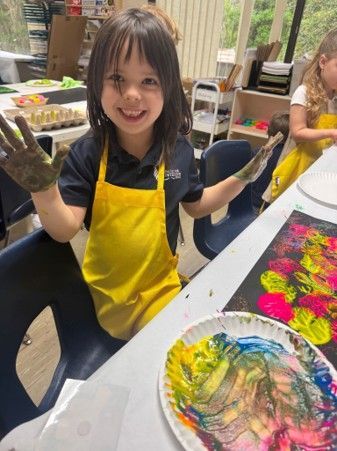
In our Art room, we use up neon red, silver, and white shimmer paint first and buy it in bulk on subscription. The fewer colors you have the better, as the kids love mixing them and coming up with their own colors–which are genuinely more beautiful than anything you can buy. Tempera paints are washable and best for practice, but if you want to paint on anything other than paper, you’ll need acrylic. It stains so use a dropcloth/Kraft paper and smock for protection, but it’s quick-drying, durable, and fairly easy to scratch off if you make a mistake. We’ve used it many times this year in the classroom with beautiful results.
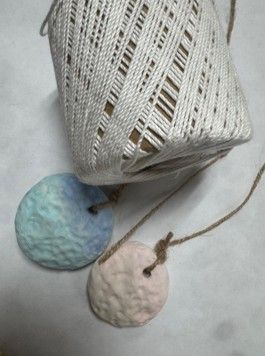
Don’t forget about sculpture! Many children who are not interested in sitting down for long stretches with paint or crayons are drawn to the kinesthetic joy of shaping clay. This year in art, kids have enjoyed the excitement of bringing their ideas to life in three dimensions with air dry clay, which is always on hand and available to them. We have created a special drying/storage area so they can use it any time. At home, you could also buy reusable plasticine or make your own clay. Here’s a recipe the kindergartners made this year in Art class during their study of Ruth Asawa.
The more art I do with children, the more I see its benefits. Children are motivated to create, and there is no better way for them to discover (and witness adults modeling) the value of persistence, the pride that comes from independent and dedicated practice, and how mistakes are not only inherent in learning but also can lead to something new or beautiful. Maybe you’re already familiar with studies showing how art programs in schools raise student performance and pro-social behaviors like empathy, but equally important, art is what makes us human: it is a uniquely human activity associated fundamentally with symbolic and abstract cognition. (While reading is localized in the left regions of the brain, making art lights up many disparate areas at the same time.)
And it’s good for the soul. Art-making deepens our connections and relationships with each other and brings us together as families, as a community, and as human beings. Just look at the crochet trend that’s taken hold of our Upper Elementary schoolers! I urge you to do it or keep doing it with your child the way you read to him/her regularly and as often as possible.